Used 2011 Toyota Ractis cars for sale
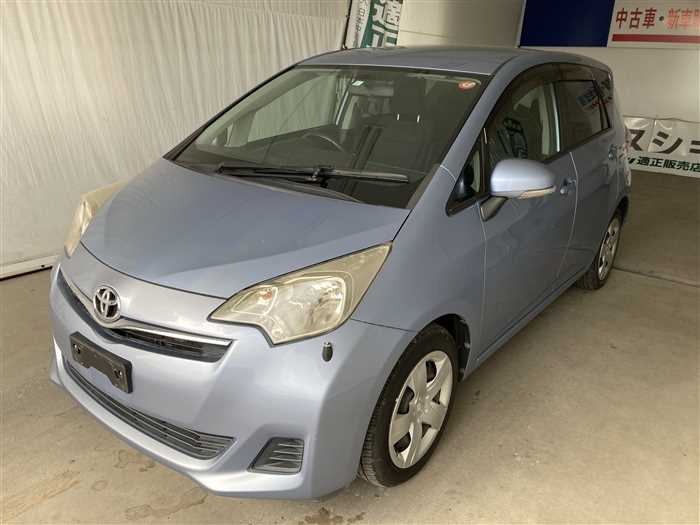
Ractis Buying Guide

The Toyota Ractis is a 'tall 5-door hatchback/mini MPV' based on the Vitz platform. Despite the compact body size of less than 4m in length and almost 1.7m in width, the lowered floor package and increased height offer an interior space and cargo capacity that exceed its class. This is its most significant feature. The front seats provide a typical passenger car driving position, and the rear seats are equipped with a slide & dive down mechanism for versatile seating arrangements. Introduced in Japan in 2005 as the successor to the Funcargo, it underwent a full model change in 2010. The second generation was sold as the 'Toyota Verso-S' in Europe and New Zealand. With its reliability typical of Japanese compact cars, easy handling size, and excellent practicality, it has remained a popular model for export and import as a used car overseas.
First-generation Ractis (NCP100/SCP100 series, 2005–2010) - The original model of high-roof compact cars with a flat cargo area.
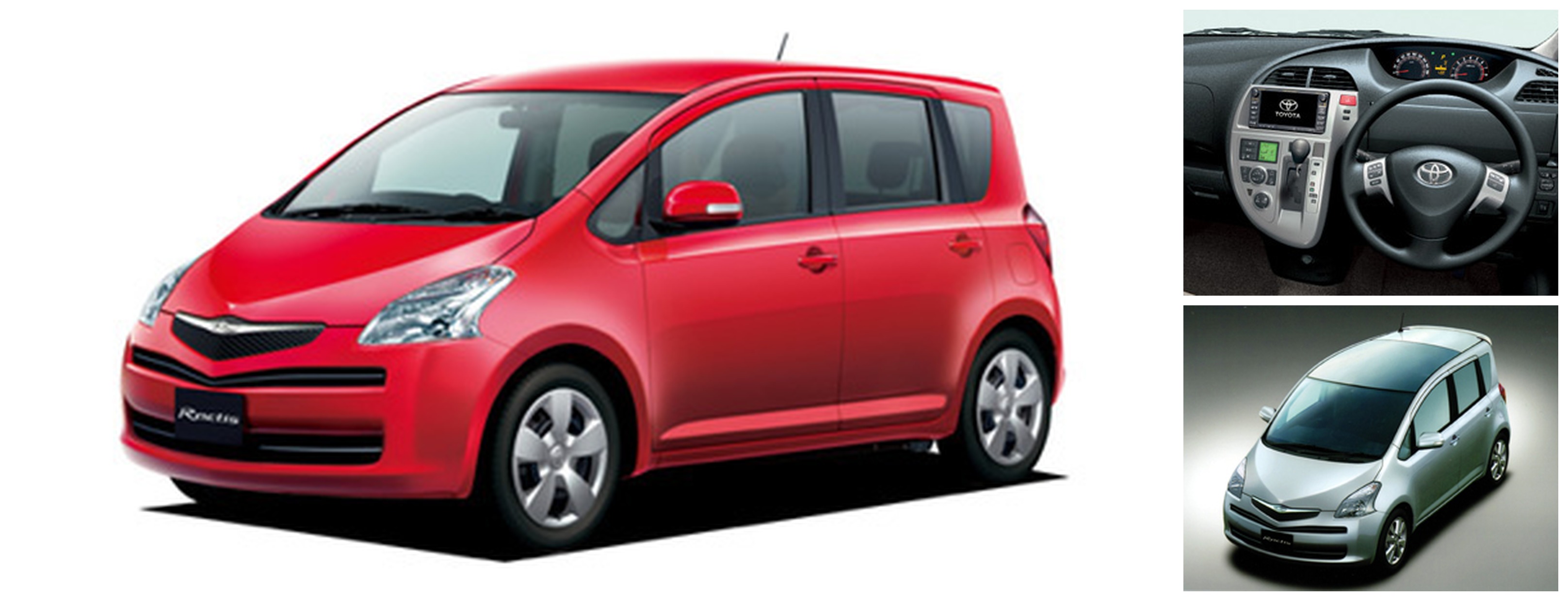
The charm of the first generation Ractis
Compact body with spacious interior and a large, flat luggage compartment.
The first-generation Ractis is a model that embodies its development concept of "High Performance & High Capacity", packing a tall cabin and spacious cargo area within its compact dimensions of 3,955mm in length and 1,695mm in width. It has a relatively long wheelbase of 2,550mm for its class, providing ample knee room in the rear seats. These rear seats also come equipped with a 6:4 split dive-down mechanism, allowing them to stow away into the floor, and making it easy to create a flat floor with minimal steps. This feature makes it easy to vertically load items like bicycles, strollers, and large suitcases, making it versatile enough for everything from everyday shopping to outdoor adventures. The engine options are the 1.3L 2SZ-FE and the 1.5L 1NZ-FE, both offering a well-balanced mix of fuel efficiency and power. Paired with a Super CVT-i (Continuously Variable Transmission), they deliver smooth acceleration and quiet performance in urban driving scenarios. Four-wheel-drive models also offer a 4-speed AT, ensuring strength and practicality for use in snowy environments or regions with many unpaved roads. This point could also be appealing from an import/export perspective.
Drawbacks of the First-Generation Ractis
"Superior high-speed stability and comfort, all in a compact car"
On the other hand, the first-generation Ractis offers driving performance and quietness within the compact car range. With a total height of 1,640 - 1,660mm, the car's center of gravity is somewhat higher compared to regular hatchbacks such as the Vitz, making the body prone to swaying in crosswinds on highways and on uneven roads. The rear suspension is a simple torsion beam design which can cause a jolt when the car is fully loaded with passengers and luggage over uneven road surfaces. The 1.3L engine model offers ample performance for city driving, but may lack power on highways and uphill roads. It may be less stressful for users who frequently travel long distances or need to carry large amounts of luggage to opt for the 1.5L model. While the CVT offers smooth acceleration, pressing the accelerator pedal hard can cause the engine to rev up first, creating a delayed acceleration impression (known as "rubber band effect"). When considering importation, this model should be chosen based on driving conditions (mainly in urban areas or frequent highway use) and engine displacement and drive system.
Rival of the first-generation Ractis
Honda Fit (first and second generation) and other B-segment hatchbacks
The direct competitors of the first-generation Ractis were higher-profile 5-door hatchbacks or mini MPVs in the Japanese B-segment, such as the Honda Fit (known as Jazz overseas), Nissan Note (E11 series), and Nissan Cube (2nd generation, Z11 model). The Fit features a "center tank layout," providing ample rear foot space and cargo area while achieving a lower height and lower center of gravity, resulting in distinct car-like handling. If you frequently drive on long-distance or winding roads, the Fit offers a slightly more enjoyable driving experience. On the other hand, the Ractis has a higher seating position with excellent visibility, and large door openings for ease of entry and exit and convenient handling of child seats. While the Note (E11 series) is appealing for its sliding rear seat and spacious rear area, there are cases where the Ractis surpasses it in terms of the flatness of the cargo floor and the dive-down mechanism of the seats. If you are considering importing from overseas, all models guarantee high-quality engines and transmissions and ample parts supply. To make selection easier, you could consider it this way: choose the Ractis if you prioritize visibility and ease of entry/exit; opt for the Fit/Note if you emphasize driving enjoyment.
First-generation Ractis Specifications
Body Type: 5-Door Hatchback/Mini MPV (5-seater) Size: Total Length 3,955mm x Total Width 1,695mm x Total Height 1,640mm (For 4WD around 1,660mm, varies depending on the grade) Wheelbase: 2,550mm Engine: 1.3L Inline-4 DOHC Gasoline (2SZ-FE / about 87ps) 1.5L Inline-4 DOHC Gasoline (1NZ-FE / about 110ps, for 4WD about 105ps) Transmission: Super CVT-i (Continuously Variable Transmission), partly 4-speed AT (mainly for 4WD vehicles) Drive System: FF (Front Wheel Drive), Full-Time 4WD 10-15 Mode Fuel Efficiency Estimate: Approximately 14.8 - 18.6km/L (varies depending on displacement and drive system) New Car Price Range in Japan: Approximately 1.36 million - 1.8 million yen (Excluding special edition, representative values)
Second Generation Ractis (NCP120/NSP120 Series, 2010-2016) ~ Sophisticated Design Inherited from European Verso-S and Enhanced Package
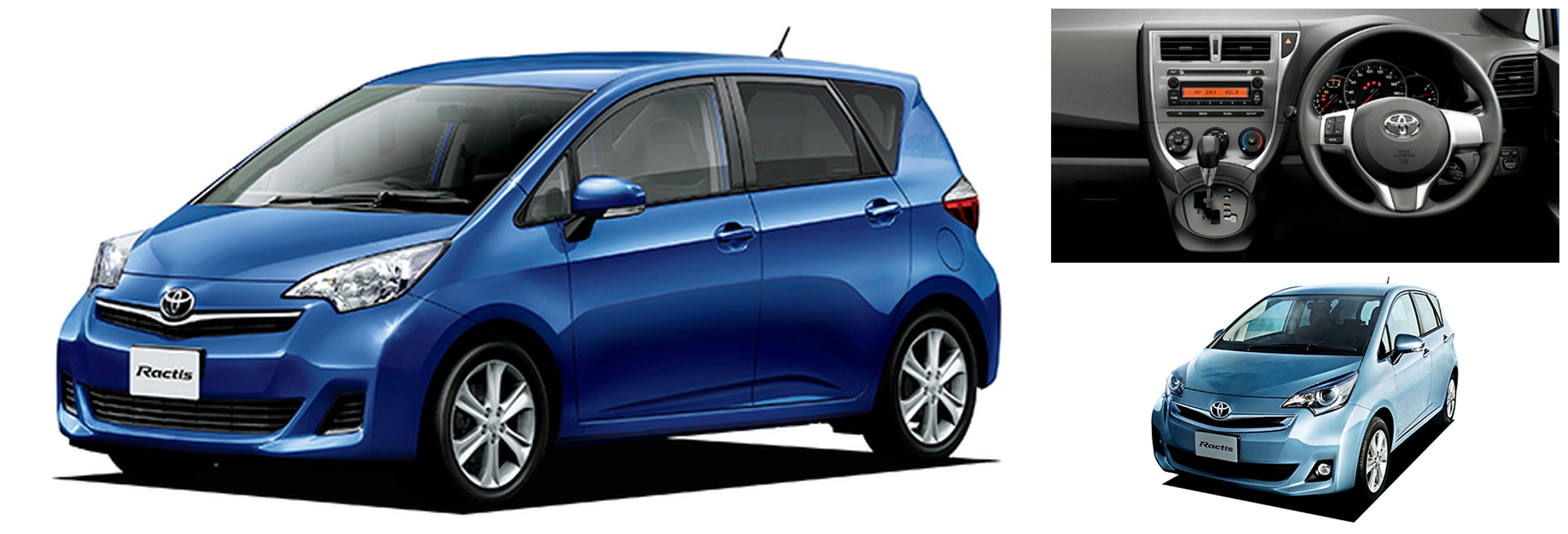
The charm of the second-generation Ractis
A later model that refines driving and comfort while maintaining user-friendliness.
The second-generation Ractis (NCP120/125・NSP120) is a model that has significantly improved both the design and ride quality while inheriting the packaging of its predecessor. The overall length has been slightly extended to 3,995mm but still maintains a compact size under 4m. The total height is approximately 1,585 to 1,605mm, about 50mm lower than the first generation, increasing driving stability due to the lower center of gravity. Meanwhile, the cabin width has been expanded by approximately 40mm, providing more shoulder room. The engine lineup consists of a new generation 1.3L (1NR-FE/1NR-FKE, about 95-99ps) and a matured 1.5L 1NZ-FE (109ps in 2WD and 103ps in 4WD), both of which are paired with the Super CVT-i for optimal fuel efficiency and smooth acceleration. The grade lineup includes the basic X, well-equipped G, and sporty S with European-styled handling and paddle shifts. This model was also sold as the Verso-S in Europe, with advanced stability during high-speed cruising and soundproofing than the first generation.
Disadvantages of the Second Generation Ractis
Opinions may differ on the design and seat preferences, and there is no hybrid option available.
Firstly, the second-generation Ractis may not appeal to everyone due to its design, and preferences over the seating arrangement. The front mask emphasizes a wide and low design, however, some voice concerns that it is less charming and is more mundane compared to the adorable, compact high-roof of the first generation. Having changed the center meter layout to a more conventional one, there are users who complain that it lost its unique Ractis character. Furthermore, while Toyota was expanding its range of hybrids like the Aqua and Prius during the same period, Ractis did not feature a hybrid model. Therefore, in terms of fuel economy and in regions with strict emission regulations, it may seem less attractive compared to its later hybrid compact car counterparts. Additionally, due to the high body and large tailgate, it may feel a bit shaky in crosswinds and strong overtaking winds, and its high-speed stability should be realistically considered to be equivalent to that of the B-segment.
Rival of the second-generation Ractis
Honda Fit (2nd generation GE series) / Toyota Yaris 3rd generation, etc.
The main rivals of the second-generation Ractis include B-segment hatchbacks/mini MPVs such as the Honda Fit (2nd generation GE6/GE8), Toyota Vitz, Nissan Note (2nd generation E12), and Nissan Cube (3rd generation Z12). In particular, the second-generation Fit had a major advantage in fuel efficiency due to the addition of hybrid models and highly efficient engines. On the other hand, the Fit and Vitz are slightly lower in height, so the Ractis is superior in terms of ease of getting in and out and headroom. One of the strengths of the Ractis is its extensive utility equipment that works in actual loading and unloading scenarios, such as a 6:4 split tilt-down mechanism for the rear seats, and a "remote folding" feature that allows you to fold the seats with a single lever from the cargo area. In the European market, it competed with the Toyota Verso (C-segment MPV) and other small MPVs (Honda Jazz/Fit, Suzuki Splash, etc.), but its easy maneuverability with a length less than 4m and its reliability were highly rated. When considering imports, comparing in terms of "Fit/Hybrid if you prioritize fuel efficiency" and "Ractis/Verso-S if you prioritize load capacity and ease of ingress and egress" will make it easier to choose what suits your needs.
Specifications of the Second-Generation Ractis
Body Type: 5-door hatchback/mini MPV (seats 5) Size: Overall length 3,995mm x width 1,695mm x height 1,585mm (for 4WD models approximately 1,605mm) Wheelbase: 2,550mm Engine: 1.3L inline 4-cylinder DOHC gasoline (1NR-FE/around 95ps, later type 1NR-FKE around 99ps) 1.5L inline 4-cylinder DOHC gasoline (1NZ-FE/2WD around 109ps, 4WD around 103ps) Transmission: Automatic continuously variable transmission Super CVT-i (grades available with 7-speed Sport Sequential mode) Drive system: FF (front wheel drive), 4WD (mechanical full-time) JC08 mode fuel economy: approximately 16 to 20.6km/L (varies based on displacement, drive system, and whether idle stop is installed or not) Price range when new (in Japan): Approximately 1.37 million yen to around 1.8 million yen (varies based on grade and special edition)